Managing Heat Stress in Greenhouse Environments
Summer greenhouse management presents unique challenges as external temperatures soar and solar radiation intensifies. Effective cooling strategies are essential for maintaining optimal growing conditions while managing energy costs and ensuring plant survival during extreme heat events.
Successful summer cooling requires a multi-faceted approach combining ventilation, evaporation, shading, and thermal management techniques. Understanding the principles behind each cooling method enables growers to design comprehensive cooling systems that maintain productivity even during the hottest weather.
Understanding Heat Load Sources
Effective cooling system design begins with understanding all sources of heat gain in greenhouse environments. Identifying and quantifying these heat sources enables targeted cooling strategies that address specific thermal challenges.
Primary Heat Sources:
- Solar Radiation: Direct sunlight through glazing materials (largest heat source)
- Equipment Heat: Pumps, fans, lighting, and control systems
- Plant Transpiration: Latent heat release from plant water evaporation
- Soil Heat Storage: Thermal mass effects from floors and growing media
- Infiltration: Hot air entering through gaps and openings
Natural Ventilation Optimization
Natural ventilation forms the foundation of greenhouse cooling systems, using thermal buoyancy and wind forces to remove hot air and introduce cooler outside air when conditions permit.
Ventilation Design Principles
Effective natural ventilation requires proper sizing, positioning, and control of inlet and outlet vents to maximize air exchange while maintaining uniform temperature distribution.
Vent Sizing Guidelines:
- Total Vent Area: 15-25% of floor area for adequate air exchange
- Roof Vent Area: 10-15% of floor area for hot air exhaust
- Side Vent Area: 5-10% of floor area for cool air intake
- Ridge Vent Continuous: Full-length ridge vents for maximum exhaust capacity
- Windward/Leeward Positioning: Strategic placement for wind-driven ventilation
Automated Vent Control Systems
Automated vent control systems optimize natural ventilation by continuously adjusting vent openings based on temperature, humidity, and wind conditions.
Control System Features:
- Temperature-Based Control: Automatic vent opening based on set points
- Wind Speed Integration: Reduced vent opening during high winds
- Rain Closure: Automatic vent closure during precipitation
- Staged Operation: Gradual vent opening for smooth temperature control
- Emergency Ventilation: Full vent opening during equipment failures
Mechanical Ventilation Systems
Mechanical ventilation systems provide reliable air exchange independent of wind conditions, ensuring adequate cooling even during calm weather periods when natural ventilation is insufficient.
Exhaust Fan Systems
Exhaust fan systems create negative pressure that draws hot air from the greenhouse while pulling cooler outside air through inlet openings.
Fan System Design Criteria:
- Air Exchange Rate: 1-2 air changes per minute for adequate cooling
- Fan Capacity: Sized for peak summer heat loads
- Staged Operation: Multiple fans for variable capacity control
- Inlet Area Ratio: 1.4:1 inlet to fan area for proper air distribution
- Fan Placement: Leeward wall installation for optimal air movement
Pressure Ventilation Systems
Pressure ventilation systems use supply fans to create positive pressure, forcing hot air out through outlet vents while ensuring controlled air distribution.
Pressure System Advantages:
- Uniform Air Distribution: Better control of air movement patterns
- Filtration Capability: Option to filter incoming air
- Precise Control: Better temperature uniformity throughout greenhouse
- Pest Exclusion: Positive pressure prevents pest infiltration
Evaporative Cooling Systems
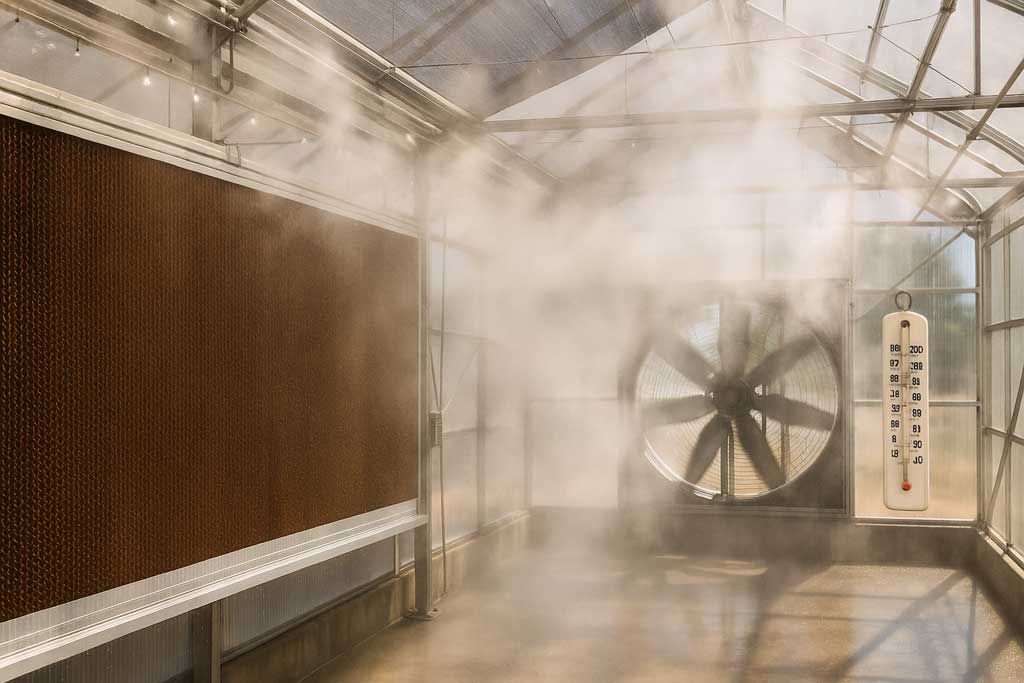
Evaporative cooling systems provide substantial temperature reduction by using water evaporation to remove heat from the air stream, offering energy-efficient cooling in dry climates.
Pad and Fan Cooling
Pad and fan systems draw outside air through wet cooling pads, reducing air temperature through evaporative cooling before circulating cooled air throughout the greenhouse.
Pad and Fan System Components:
- Cooling Pads: Cellulose or rigid media with high surface area
- Water Distribution: Uniform water application across pad surface
- Exhaust Fans: Variable speed fans for airflow control
- Water Recirculation: Pump and reservoir systems for water recycling
- Drainage Systems: Collection and disposal of excess water
Fog Cooling Systems
High-pressure fog systems create fine water droplets that evaporate quickly, providing cooling while adding humidity to the greenhouse environment.
Fog System Advantages:
- Rapid Cooling: Immediate temperature reduction when activated
- Humidity Control: Ability to increase humidity during dry periods
- Flexible Application: Zone-specific cooling capabilities
- Low Water Usage: Efficient water utilization through complete evaporation
Shading Systems and Heat Reduction
Shading systems reduce solar heat gain by blocking or reflecting solar radiation before it enters the greenhouse, providing the most energy-efficient method of cooling.
External Shading Systems
External shading systems intercept solar radiation outside the greenhouse structure, preventing heat buildup and reducing cooling system demands.
External Shading Options:
- Retractable Shade Cloth: Automated systems that deploy based on light levels
- Fixed Shade Structures: Permanent structures for season-long shading
- Whitewash Application: Temporary reflective coatings applied to glazing
- Shade Net Installation: Removable fabric systems for seasonal use
Internal Shading Systems
Internal shading systems reduce direct solar radiation on plants while allowing diffused light penetration, providing crop protection without completely blocking photosynthesis.
Internal Shading Benefits:
- Crop Protection: Prevents leaf burn and heat stress
- Temperature Uniformity: Reduces hot spots under direct sun
- Light Diffusion: Spreads light more evenly throughout canopy
- Automated Control: Responsive to light levels and temperature
Thermal Screening and Energy Curtains
Thermal screening systems provide variable heat reduction and can serve dual purposes for both summer cooling and winter energy conservation.
Motorized Screen Systems
Motorized thermal screens automatically deploy based on environmental conditions, providing precise control over light levels and heat reduction.
Screen System Features:
- Variable Opacity: Different screen materials for varying light reduction
- Automated Deployment: Light and temperature-based control systems
- Partial Closure: Graduated shading for precise light control
- Dual Function: Summer cooling and winter energy conservation
Structural Cooling Enhancements
Greenhouse structural modifications can significantly improve cooling efficiency by reducing heat gain and improving air circulation patterns.
Roof Design Modifications
Roof design significantly impacts greenhouse cooling performance, with specific configurations providing better heat dissipation and air movement.
Cooling-Optimized Roof Features:
- Increased Roof Slope: Steeper slopes improve natural convection
- Ridge Vent Enhancement: Larger ridge openings for better hot air exhaust
- Reflective Glazing: Heat-reflective polycarbonate or glass options
- Roof Sprinkler Systems: External water application for evaporative cooling
Air Circulation Improvements
Strategic placement of circulation fans and air movement systems improves temperature uniformity and cooling system effectiveness.
Circulation Enhancement Strategies:
- Horizontal Air Flow (HAF) Fans: Continuous air movement for temperature uniformity
- Destratification Fans: Vertical air mixing to eliminate temperature layers
- Perimeter Air Movement: Targeted circulation along greenhouse walls
- Variable Speed Control: Adjustable fan speeds based on cooling needs
Plant-Based Cooling Strategies
Plant management techniques can contribute to greenhouse cooling by optimizing transpiration rates and reducing heat stress on crops.
Transpiration Management
Proper irrigation and humidity management optimize plant transpiration, which provides natural cooling while maintaining plant health.
Transpiration Optimization:
- Adequate Soil Moisture: Maintain optimal root zone moisture for transpiration
- Humidity Control: Balance humidity to encourage transpiration without stress
- Air Movement: Provide air circulation to remove moisture around leaves
- Root Zone Cooling: Cool irrigation water to reduce plant heat stress
Crop Selection and Timing
Strategic crop selection and production timing can reduce cooling demands by growing heat-tolerant varieties during peak summer periods.
Heat Management Through Crop Planning:
- Heat-Tolerant Varieties: Select cultivars adapted to high temperatures
- Production Scheduling: Time sensitive crops for cooler periods
- Crop Density Management: Reduce plant density to improve air circulation
- Canopy Management: Prune and train plants for better air movement
Advanced Cooling Technologies
Emerging cooling technologies offer innovative solutions for extreme climate conditions and energy-efficient temperature management.
Ground-Coupled Heat Exchangers
Ground-coupled systems use stable soil temperatures to pre-cool incoming ventilation air, providing energy-efficient temperature reduction.
Earth Tube System Benefits:
- Stable Ground Temperature: Consistent cooling regardless of outside conditions
- Energy Efficiency: Passive cooling with minimal energy input
- Year-Round Operation: Cooling in summer, heating assistance in winter
- Low Maintenance: Simple systems with minimal moving parts
Phase Change Material (PCM) Systems
Phase change materials absorb and release thermal energy during melting and solidification, providing thermal buffering during temperature extremes.
PCM System Applications:
- Thermal Mass Enhancement: Increased thermal storage capacity
- Temperature Buffering: Reduced temperature fluctuations
- Peak Load Reduction: Lower cooling system capacity requirements
- Night Cooling Recovery: Heat release during cooler nighttime periods
Energy-Efficient Cooling System Design
Designing energy-efficient cooling systems requires careful consideration of cooling loads, system sizing, and operational strategies that minimize energy consumption while maintaining effective temperature control.
Integrated System Approach
The most effective cooling systems integrate multiple technologies in a coordinated approach that optimizes cooling efficiency while minimizing energy costs.
System Integration Strategies:
- Staged Cooling: Sequential activation of cooling systems based on demand
- Natural Ventilation Priority: Maximum use of free cooling when available
- Evaporative Cooling Optimization: Use during optimal humidity conditions
- Mechanical Backup: Reliable cooling during extreme conditions
Monitoring and Control Systems
Advanced monitoring and control systems optimize cooling system operation by continuously adjusting cooling strategies based on real-time conditions and plant needs.
Environmental Monitoring
Comprehensive monitoring systems track multiple environmental parameters to enable precise cooling system control and optimization.
Critical Monitoring Parameters:
- Temperature Gradients: Monitor temperature uniformity throughout greenhouse
- Humidity Levels: Track relative humidity for evaporative cooling optimization
- Solar Radiation: Measure light intensity for shading system control
- Wind Speed and Direction: Optimize natural ventilation based on wind conditions
- Plant Temperature: Monitor leaf temperature to assess plant stress
Economic Considerations and ROI
Cooling system investments require careful economic analysis to balance initial costs with long-term operational savings and improved crop productivity.
Cost-Benefit Analysis
Comprehensive economic analysis considers all costs and benefits associated with cooling system implementation and operation.
Economic Factors:
- Initial Investment: Equipment and installation costs for cooling systems
- Operating Costs: Energy, water, and maintenance expenses
- Productivity Gains: Increased yields and improved crop quality
- Market Advantages: Extended growing seasons and premium product pricing
- Risk Reduction: Protection against heat-related crop losses
Emergency Cooling Protocols
Emergency cooling protocols ensure rapid response to extreme heat events that could threaten crop survival and greenhouse operations.
Heat Emergency Response
Preparation for extreme heat events includes emergency procedures and backup systems that can be rapidly deployed when standard cooling systems are insufficient.
Emergency Procedures:
- Emergency Ventilation: Maximum vent opening and fan operation
- Additional Shading: Temporary shade installation during extreme conditions
- Supplemental Irrigation: Increased watering to support plant transpiration
- Crop Protection: Temporary covers or relocating sensitive plants
- Staff Safety: Protocols for worker protection during extreme heat
Effective summer cooling requires a comprehensive approach that combines multiple cooling strategies with intelligent control systems and emergency preparedness. By implementing appropriate cooling technologies and management practices, greenhouse operators can maintain optimal growing conditions even during the most challenging summer weather, ensuring continued productivity and crop quality throughout the hottest months of the year.
 English
  Spanish
  French
  German
  Portuguese
  Arabic
  Russian
  Chinese